
Expressvpn Glossary
Edge network
What is an edge network?
An edge network is a type of network that processes and delivers data closer to end users or devices rather than relying solely on centralized data centers.
How does an edge network work?
An edge network uses edge nodes, which are distributed servers or computing systems. These edge nodes may be deployed in data centers, telecommunications facilities, branch offices, or local gateways, depending on the architecture.
When a user or device connects to a service, the request is handled by the most appropriate edge node based on routing policies and network conditions. The edge node may deliver cached content, execute application logic, filter or optimize traffic, or perform security functions. If additional processing or data is required, the request is forwarded to a centralized cloud or core infrastructure.
Types of edge network
Edge networks can be of various types depending on their location and objectives: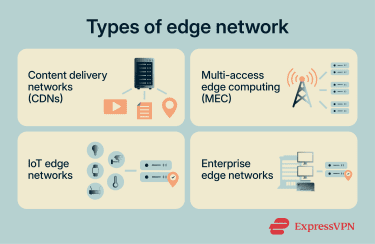
- Content delivery networks (CDNs): Use distributed edge servers that cache and deliver content from locations near end users and may also perform processing or security functions.
- Multi-access edge computing (MEC): Deployed within telecommunications networks, where computing and storage resources are integrated into mobile base stations or regional carrier facilities.
- Internet of Things (IoT) networks: Architectures that process and filter device-generated data near the point of origin before forwarding selected data to centralized systems.
- Enterprise edge networks: Distributed computing and networking infrastructure deployed across branch offices, campuses, or remote business locations.
Why is an edge network important?
An edge network improves performance, resilience, and traffic efficiency by distributing resources closer to users. Key benefits include:
- Reduced latency: Placing edge nodes closer to users lowers response times for interactive services.
- Improved reliability: Distributing infrastructure reduces dependence on a single central server.
- Lower bandwidth usage: Caching frequently requested data decreases backbone traffic and origin server load.
- Localized policy enforcement: Enables regional access controls and supports regulatory compliance at the local level.
- Proactive threat mitigation: Allows traffic inspection and mitigation closer to the source of potential attacks.
Where is it used?
Edge networks are used in environments where low latency, high reliability, or localized processing is required. They are commonly deployed to accelerate web and media delivery, support 5G and telecommunications services, process data from IoT devices, and extend cloud capabilities closer to end users.
Edge architectures are also used in industries such as manufacturing, healthcare, transportation, and smart cities.
Risks and privacy concerns
Edge networks can introduce risks related to:
- Metadata exposure: Edge nodes can access routing data and IP addresses, which may reveal user behavior patterns.
- Cache misconfiguration: Improper cache rules may serve private or user-specific data to unintended users.
- Third-party dependency: Organizations rely on the availability, trust model, and security practices of edge service providers.
- Log retention risks: Edge systems generate and store traffic logs that may increase exposure if retained improperly.
Further reading
- Internet infrastructure: What it is and how it works
- What is a CDN? Understanding content delivery networks
- What is Secure Access Service Edge (SASE)?
- Understanding domain fronting: A comprehensive guide