
Expressvpn Glossary
Firewall rules

What is a firewall rule?
A firewall rule is an instruction that tells a firewall whether to allow, block, or monitor network traffic based on defined conditions. These rules control how data moves between networks, devices, or applications and help protect systems from unauthorized access.
How do firewall rules work?
When a data packet attempts to enter or leave a network, the firewall checks the packet against its rules based on attributes of network traffic, such as the source IP address, destination IP address, protocol, and port number.
If the traffic matches the conditions of a rule, the firewall applies the action associated with that rule, such as allowing or blocking the connection. Rules are evaluated in a specified order, and the firewall checks them until it finds the rule that matches the packet. Once a matching rule is found, its action is applied, and the firewall usually stops evaluating further rules for that packet.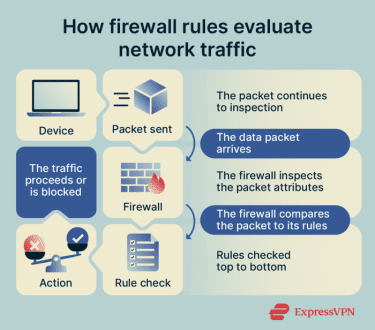
Common firewall rule categories
Firewall rules can vary depending on the direction of network traffic, the action applied to matching traffic, or the criteria used to filter connections.
- Inbound rules: Control traffic coming into a network or device from external sources.
- Outbound rules: Control traffic leaving a network toward external systems.
- Allow rules: Permit specific network traffic that matches defined criteria, such as traffic from a trusted IP address or to a specific port.
- Deny or block rules: Prevent traffic that matches certain conditions from entering or leaving the network.
- Logging rules: Instruct the firewall to record information about matching traffic for monitoring, troubleshooting, or security analysis.
- Application rules: Restrict or allow traffic based on the application generating the request.
- Protocol or port rules: Filter traffic based on network protocols or port numbers used by services.
Common use cases
Firewall rules are widely used to manage and secure network traffic across organizations and digital systems. Typical use cases include:
- Allowing access to public services such as websites or email servers.
- Blocking known malicious or suspicious traffic.
- Restricting administrative access to specific internal networks.
- Controlling which applications can communicate with external services.
- Preventing unauthorized connections to sensitive systems or databases.
Key considerations for firewall rules
While firewall rules help control network traffic and improve security, problems can arise with:
- Misconfiguration: Incorrect rule order, overly permissive rules, or overly restrictive settings may allow unauthorized access or block legitimate traffic and services.
- Rule complexity: Large or poorly documented rule sets can become difficult to manage, increasing the likelihood of errors, conflicts, or outdated rules remaining active.
- Logging and monitoring: Firewall logs may contain IP addresses, timestamps, and connection metadata that reveal patterns of user or device activity if not properly secured.
Further reading
- What is a firewall, and how does it work
- VPN vs. firewall: Key differences and when to use each
- NAT “firewall”: Everything you need to know about network security