
Expressvpn Glossary
Hybrid cloud storage
What is hybrid cloud storage?
Hybrid cloud storage is a data management approach that combines local or private storage with cloud-based, public storage services. Integrating the two storage systems allows users to separate their data into different environments, depending on policy, requirements, or workload needs.
How does hybrid cloud storage work?
Hybrid cloud storage involves an organization using both private and public cloud-based storage infrastructure at the same time. These systems are linked together through management software, APIs, or cloud gateways, which allows information to be shared, synced, and moved quickly.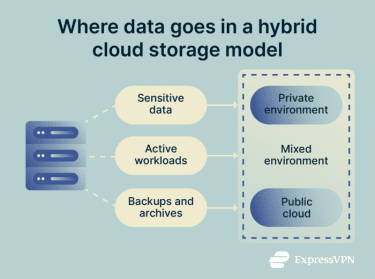
Organizations choose where types of data are stored. For example, the most sensitive files may be kept on on-premises devices, other data sent to the cloud, and some data, like active workloads, stored across both environments.
Some implementations may use automated tiering, a process that monitors how frequently data is accessed and automatically moves it between environments accordingly. Security controls like encryption and access controls can be used to help prevent leaks, losses, and unauthorized access.
Why is hybrid cloud storage important?
- Scalability: Businesses can easily expand their storage capabilities without having to invest in new infrastructure.
- Compliance: A hybrid model makes it easier for organizations to abide by regulations regarding data privacy, such as the General Data Protection Regulation (GDPR), by storing sensitive data privately.
- Resilience: Having some data on the cloud (including backups) can help with disaster recovery and enable continuity during unexpected outages.
- Cost-effective: It can be more affordable to operate on a hybrid model rather than investing in large amounts of on-premises hardware.
Risks and privacy concerns
Despite its advantages, hybrid cloud storage comes with potential risks:
- Misconfiguration may inadvertently expose sensitive data.
- Spreading data around different systems reduces visibility.
- If data isn’t secure (encrypted) during transfer, it may be intercepted.
- Compliance gaps can appear across public and private environments.
- The use of third-party cloud services can expand a business’s attack surface.
Common use cases of hybrid cloud storage
Hybrid cloud storage is used across industries where data volume, compliance requirements, or performance needs vary across different types of information.
- Healthcare, finance, and other highly regulated industries.
- Organizations with remote and hybrid workforces.
- Businesses relying on legacy infrastructure.
- Backup and disaster recovery systems.
- Analytics and burst workloads.
Further reading
- What is cloud networking? A comprehensive overview
- Security concerns in cloud computing and how to address them
- What is a virtual private cloud (VPC)?
- What is network-attached storage (NAS)?
- Network File System (NFS): A secure guide for remote access